PowerPoint Presentation: Asian Service Center

Asian Service Center


The Asian Service Center (ASC) is a new nonprofit serving Asian and underserved communities in Snohomish County, Washington. With a board and staff largely coming from for‑profit backgrounds, ASC is still learning how to operate in a nonprofit landscape that is already crowded and competitive. The organization focuses on healthcare access, family support, senior services, and youth development.

I joined ASC during its early formation, supporting leadership with communication, planning, and social media outreach. While major decisions were made by the board and executive team, I contributed by strengthening internal communication and helping shape early outreach efforts. Guided by my Christian values of service and compassion, I approached the work with empathy and a learner’s mindset, applying user‑centered thinking to help ASC build clearer messaging and stronger community engagement as it established its foundation.

Test Site: https://asianservicecenterwa.dreamhosters.com

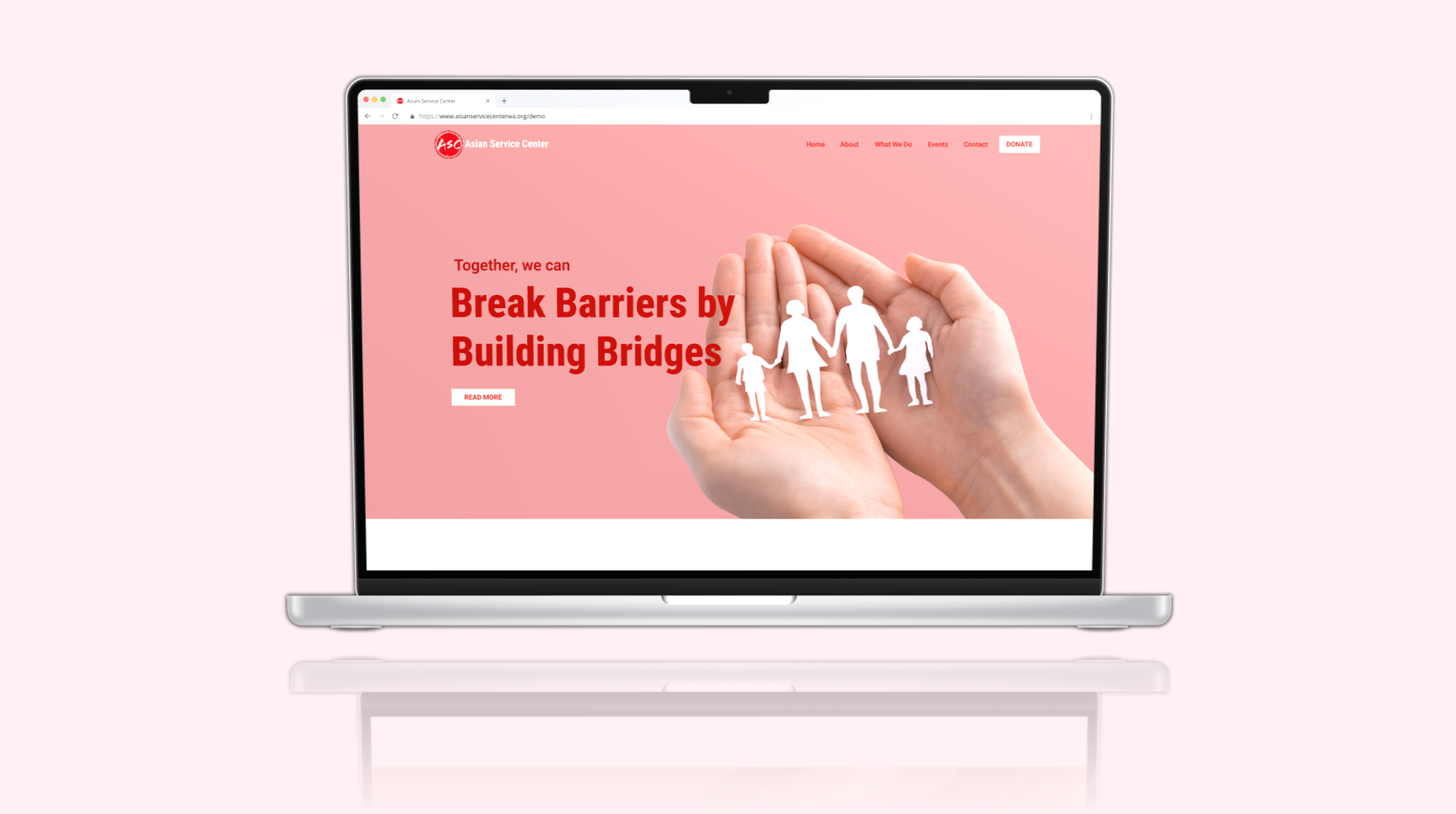
Completely revamped the Asian Service Center website to specify its services

Making their website modern and functional

Featured strategies for better donation, donor fundraising engagements, and gaining potential clients we aim to serve

Communities face challenges of meeting their essential needs relating to healthcare, family support, senior support, and youth development.

Former website created by someone else was too general and resulted in not receiving Google AdSense grant.

The Donate button is not prominently placed and easily accessible on every page, which is crucial for encouraging donations.

E-mail contact lacks security without having a general email contact info.

User Experience, User Research, User Interface, Usability Testing, Design System

Identifying the Challenges


ASC’s communities face multiple barriers that limit access to essential services and opportunities.

Key Challenges:

• Significant barriers to healthcare, including language differences, lack of insurance, and limited awareness of available resources

• Families and individuals lack the support systems needed to thrive

• Seniors experience isolation and insufficient care

• Youth lack access to academic resources, counseling support, and leadership development

Why This Matters:

These gaps prevent community members from receiving the care, guidance, and opportunities they need to achieve long‑term well‑being.

Goals and Objectives:


Building on the challenges faced by ASC’s communities, the overall goal of these program services is to expand access to essential support—improving healthcare access, strengthening families, supporting seniors, and empowering youth across Snohomish County. Each service area is designed to reduce barriers, increase awareness, and create more equitable pathways to care and opportunity.

Program Objectives

To achieve this mission, ASC aims to provide:

• Free healthcare services such as vaccinations, nutrition programs, and basic health support for underserved individuals

• Family support services, including counseling, education, and resources that help families and individuals thrive

• Senior care services offering companionship, transportation, and assistance with daily living needs

• Youth development services that provide mentorship, academic support, and leadership‑building opportunities

Together, these objectives form the foundation of ASC’s effort to create a healthier, more connected, and better‑supported community.


 Approach and Strategies:


ASC is still in the early stages of developing its programs, and much of the work so far has focused on building exposure and forming community connections. Some examples of ASC’s approach to achieving its goals include:

• Partnering with local healthcare providers to offer free healthcare services to underserved communities and following up to ensure needs are met

• Developing and distributing multilingual informational materials to increase awareness of available healthcare resources

• Engaging bilingual volunteers and community members to provide language support and help individuals navigate the healthcare system

• Providing family support services through counseling, education, and resource guidance

• Partnering with senior‑care organizations to offer companionship, transportation, and assistance with daily living activities

• Collaborating with youth‑focused programs to deliver mentorship, education, and leadership development opportunities

User Flow


The user flow process of the four programs

Community members first connect with ASC when they are looking for help, information, or a trusted place to start. Their needs may be related to health, senior care, family support, or youth development, and ASC guides them toward the most appropriate service.


Many users begin their journey with health‑related needs. ASC provides essential services that build trust and address immediate concerns.

Services include:

• Nutrition and wellness education

• Free vaccinations

• Wellness checks and cancer screenings

• Dental screenings and consultations

• Guidance on accessing additional health resources


Families supporting aging parents often transition into Senior Care services, which focus on safety, independence, and long‑term planning.

Services include:

• Home‑safety and fall‑prevention seminars

• Emergency preparedness training

• Tech‑support workshops

• Long‑term care planning

• Memory‑care and estate‑planning guidance


As families adapt to life in the U.S., ASC provides tools and resources that help them build stability and confidence.

Services include:

• Cultural orientation and citizenship assistance

• Translation, interpretation, and English learning

• Benefit‑program guidance and financial education

• Food, utility, and housing assistance

• Legal knowledge sharing and civic engagement support


Youth and parents engage with programs that support academic success, personal growth, and emotional well‑being.

Services include:

• English learning and academic support

• Leadership training and mentoring

• School supplies and college/financial‑aid guidance

• Youth camps and volunteer opportunities

• Parenting workshops


Community members may move between services as their needs evolve, with ASC serving as a consistent, culturally responsive support system throughout their journey.

Competitive Analysis


Personas


Senior Care
 Healthcare Access
Family Support
Youth Development

Quantitative Research Overview


To better understand the healthcare needs of the Asian community, I conducted a quantitative survey with more than 140 participants representing a range of ages and cultural backgrounds. During my visit to the Homage Center for Seniors, I also observed distinct groups of Chinese, Korean, and Filipino seniors interacting within the space.

These interactions revealed meaningful cultural differences that are often overlooked in the United States, where Asian communities are frequently treated as a single, uniform group. In reality, each community has its own customs, expectations, and healthcare priorities. Many participants also reported barriers such as limited English proficiency, unfamiliarity with the U.S. healthcare system, and challenges accessing culturally appropriate services.

The combined insights from the survey and on‑site observations provided a clearer picture of these diverse needs. This understanding helps inform how the Asian Service Center can design more responsive, culturally aligned healthcare support for the communities it serves. For a detailed breakdown of the data, please refer to the

Healthcare Summary Report.

Design Ideation & Concept


Building on insights from my quantitative research and observations, I developed a low‑fidelity mockup that translates community needs into a clear, culturally responsive service experience. The design focuses on how users discover and navigate ASC’s resources, emphasizing clarity, accessibility, and cultural relevance.

The mockup organizes information into intuitive pathways that reflect real user behavior. It highlights essential services with straightforward language, visual hierarchy, and culturally sensitive cues. This helps community members quickly understand where to go for support while also demonstrating ASC’s impact to donors and partners.

Key design considerations include:

• Clear entry points for users seeking health, family, senior, or youth support

• Simple navigation flows that guide users toward referrals, education, or community programs

• Culturally aware messaging that acknowledges linguistic diversity and varying levels of familiarity with U.S. systems

• Examples of outreach and community engagement to build trust and visibility

• A layout optimized for seniors, multilingual users, and first‑time visitors

Wireframing of the design mockups

Overall, the mockup establishes a supportive digital environment that empowers Asian and underserved communities to access resources confidently. The low‑fidelity format focuses on structure and flow, laying the foundation for future visual refinement.

Low-Fidelity Prototype Process


The low‑fidelity prototype focuses on creating a structure that is easy to navigate, culturally aware, and accessible for users with different levels of English proficiency. At this stage, the priority is clarity—establishing a foundation that supports the community’s needs before moving into visual refinement.

To strengthen usability, the prototype incorporates:

Intuitive Website Menu | A simple, clearly organized menu that helps users quickly locate the services they need, reducing confusion for first‑time visitors and multilingual users.

Graphic Buttons  | Distinct, easy‑to‑recognize buttons that guide users from one section to the next. These elements support seniors and users unfamiliar with digital interfaces by making interactions more straightforward.

Universal Language Images | Images that communicate meaning without relying on text, helping bridge language gaps and ensuring users with limited English proficiency can understand key information.

Intuitive pathways and interactions that guide users seamlessly


Minimal, Accessible Design | A clean layout that avoids unnecessary visual noise. By focusing on structure and clarity, the design remains accessible to seniors, multilingual users, and individuals with varying levels of digital literacy.

Streamlined Navigation | A “less is more” approach that reduces the number of steps required to move through the site. This helps users reach essential information quickly and minimizes frustration.

This low‑fidelity prototype is intentionally functional, ensuring that users can easily access the information and services they need. This early structure sets the groundwork for a culturally responsive and user‑friendly experience, keeping the final design aligned with the needs of the Asian and underserved communities ASC supports.

Primary Colors


Transition Into High Fidelity Design


Wireframing of the high-fidelity design mockups


Once the foundational structure and user pathways were established, the next step was to bring the experience to life visually. The high‑fidelity design phase focused on expressing ASC’s identity, cultural values, and mission through a polished and emotionally resonant interface.


In the high‑fidelity mockups, ASC’s branding is fully integrated to create a cohesive and welcoming experience. The color palette reinforces consistency across the interface, while the chosen typography balances aesthetic appeal with readability, ensuring users of all ages can comfortably engage with the content.

Infographic icons are placed thoughtfully alongside key text elements to support universal comprehension. These visual cues help bridge linguistic and cultural differences, making the interface more intuitive for users from diverse Asian backgrounds.


Imagery plays a central role in reinforcing ASC’s mission. Each photo is selected to reflect themes of connection, support, and resilience—showcasing real community interactions and culturally familiar moments. These visuals help users feel represented and understood, fostering trust and a sense of belonging.

Together, these elements embody ASC’s tagline, “Breaking Barriers, Building Bridges.” The blend of colors, fonts, icons, and imagery creates a narrative of unity and empowerment, reinforcing ASC’s commitment to inclusivity while encouraging users to engage with and support the organization’s work.

High-Fidelity Prototyping


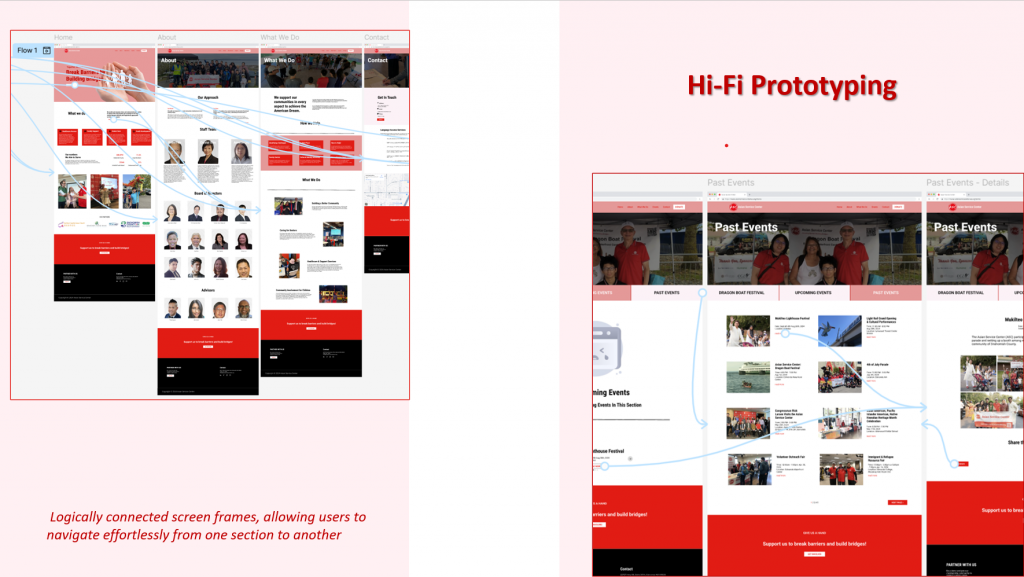
Building on the structure established in earlier stages, the high‑fidelity prototype focuses on creating a polished, emotionally resonant experience that reflects ASC’s mission and values. In revamping the ASC website, my goal was to design an interface that speaks to both donors and clients—two audiences with distinct needs but a shared connection to community support.

The high‑fidelity design brings ASC’s visual identity to life through a harmonious color palette, clean typography, and a refined layout that guides users naturally through the site. These elements work together to create a cohesive and welcoming environment where users can easily explore services, learn about programs, and connect with ASC staff.

A key emphasis of this phase was showcasing ASC’s community‑focused and outreach events. By highlighting real activities and engagement opportunities, the design encourages donors to participate in philanthropy and support ASC’s ongoing programs. The interface is crafted to be both visually appealing and highly functional, fostering a sense of belonging and reinforcing ASC’s role as a trusted community resource.


 Logically connected screen frames, allowing users to navigate effortlessly from one section to another


Thoughtfully selected imagery and icons further enhance clarity and inclusivity. These visuals reflect themes of connection, cultural identity, and mutual support—helping users feel represented and understood while navigating the site.

Overall, the high‑fidelity prototype blends visual storytelling with practical usability, creating an experience that resonates with the diverse Asian and underserved communities ASC serves.

Usability Testing


With the high‑fidelity prototype complete, the next step is to evaluate how well the design supports real user goals. Usability testing focuses on ensuring that donors can easily explore ASC’s mission, understand sponsorship opportunities, and complete a donation, while clients can quickly locate nearby services and access the resources most relevant to their needs. This phase validates whether the polished design performs effectively in real‑world scenarios and supports users with clarity and confidence.

Impact & Future Outlook


The test site serves as an important starting point for ASC as the organization continues shaping its mission, vision, and long‑term service model. It provides a tangible digital foundation the board can reference while determining how the website can best support future programs and community engagement.

One early advantage of the test site is its ability to support key engagement actions. The platform offers straightforward access to purchasing event tickets, making donations, joining as a member, and exploring volunteer opportunities, giving ASC a preview of how the site can strengthen donor and community connections once the organization’s direction becomes more clearly defined.

Public awareness is still developing, but the test site lays essential groundwork for future growth, whether through volunteer involvement, access to services, or culturally responsive programming. As ASC continues shaping its identity, the platform can reflect community needs while ensuring that any expression of the organization’s values remains balanced and inclusive.

Looking ahead, the website has the potential to evolve into a central hub for connection, support, and engagement. It represents a strong beginning, one that will grow alongside ASC as its programs, partnerships, and vision continue to take shape.

Test site: https://asianservicecenterwa.dreamhosters.com/